


Common Questions
“Every specific vocation is in fact born of the initiative of God; it is a gift of the Love of God! He is the One who takes the 'first step,' and not because he has found something good in us, but because of the presence of his own love “poured out into our hearts through the Holy Spirit” (Romans 5:5). Love of God, which priests and consecrated persons are called to mirror, however imperfectly, is the motivation for answering the Lord’s call to special consecration through priestly ordination or the profession of the evangelical counsels. Saint Peter’s vehement reply to the Divine Master: 'Yes, Lord, you know that I love you' ( John 21:15) contains the secret of a life fully given and lived out, and thus one which is deeply joyful.”– Pope Benedict XVI, Message for the 2012 World Day of Prayer for Vocations

About discernment in general...
God calls each soul in a unique way, so there are no hard-and-fast rules for discerning His call, but some practical steps that our Sisters have found helpful include:
- Attending Mass daily, or as frequently as possible
- Spending time often with our Eucharistic Lord, and if possible committing to a regular time of Eucharistic Adoration at least weekly
- Reading Sacred Scripture, the lives of the Saints, and other spiritual books
- Seeking advice from a priest or a religious you know, and if possible committing to regular spiritual direction
- Learning more about the Evangelical Counsels and about the charisms of different institutes
- Making a Marian Consecration such as the one outlined by St. Louis de Montfort
- Spending time in silence, and minimizing use of electronics and social media
- Examining in prayer your interests and attractions, and whether they may have any bearing on your vocation
- Contacting and/or visiting religious communities
It is difficult to be truly open and attentive to the Lord's call unless we are at peace. Any desire for God in your heart was placed there by Him, and He will fulfill that desire in His own way and His own time. So do not worry. God really does want you to know His will for you, and He will show it to you in His time. Entrust your vocation to our Blessed Mother, asking her to guide you and to share with you her own spirit of loving “fiat” to whatever God may ask.
To be eligible to enter our community, a woman must be a baptized, confirmed, and practicing Catholic between the ages of 18 and 35, be unmarried, and have no serious obligations or outstanding debt. (We may be able to suggest resources for those who are discerning a vocation but currently have student debt.) Although candidates must be at least 18 years old to enter, they are welcome to begin discerning with us before reaching the age of 18.
About our way of life in general...
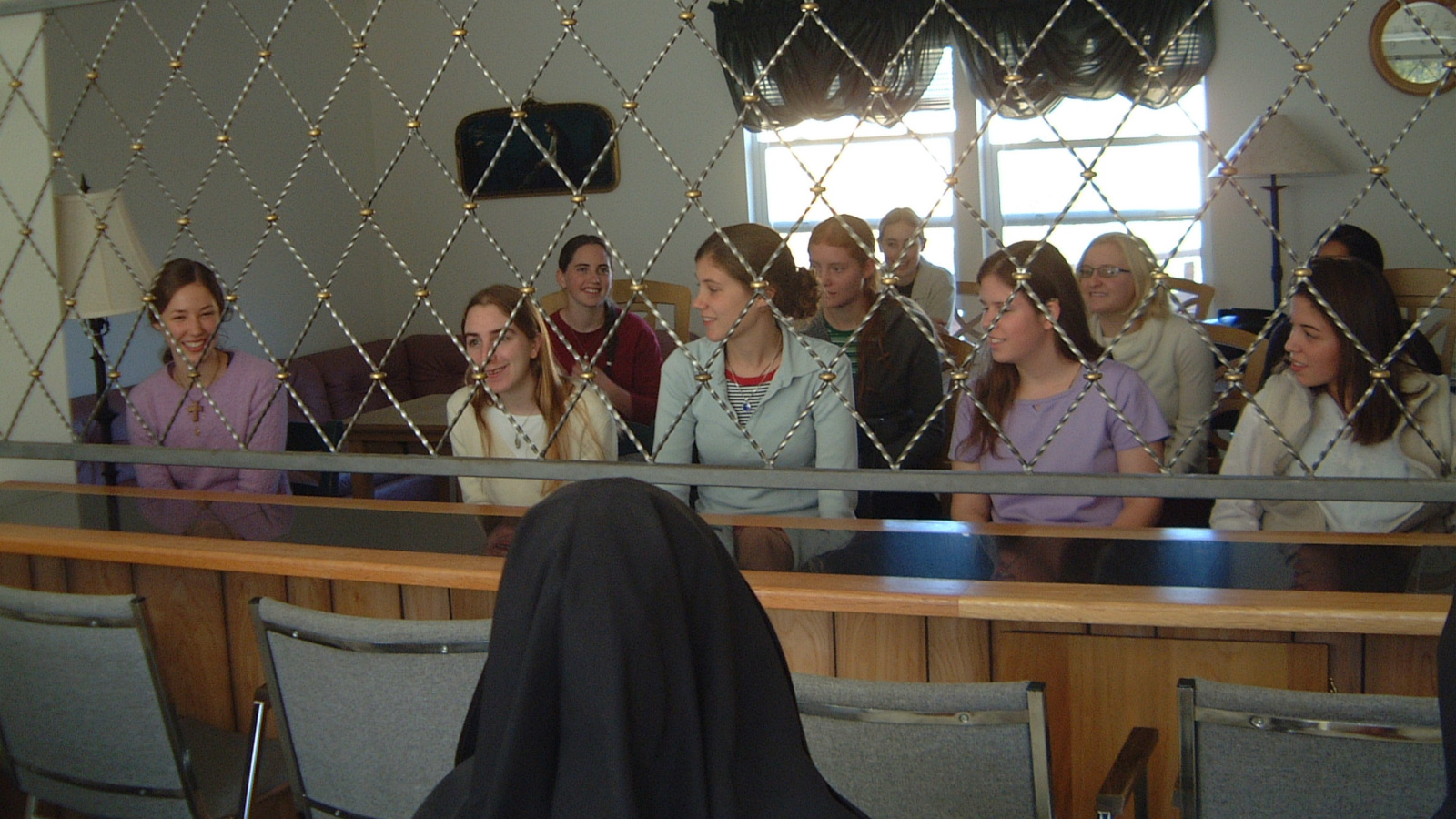
The cloister is both a sign and a means of our radical separation from the world for the sake of offering ourselves more fully to God. Cloistered nuns are “a sign of the exclusive union of the Church as Bride with her Lord, whom she loves above all things “(Verbi Sponsa, n 4). All Christians are called to follow Christ, and to be sacrificed with Him in some way according to their particular vocation. What characterizes the cloistered nun is that she withdraws from the world to give her whole life as fully as possible to this following of Him and participation in His sacrifice, without the addition of an external apostolate outside the monastery. She leaves her cloister only in cases of necessity (such as doctor visits) and does not make home visits. Her separation from the world is a concrete and visible one, marked by the delineation of the enclosure (the area of the monastery property reserved exclusively for the nuns) and the lattice-work grille between the nuns and guests in the chapel and guest parlor. This voluntary separation enables her to make a continual, ceaseless offering, as she spends herself in worship of God day and night. She is freed from worldly business and distractions which would pull her away, if only temporarily, from her work of praising God. She finds that, more and more, she loves and longs for the cloister, this lonely place which gives her space to belong wholly to the Beloved. Without real distance from the noise and bustle of the world, her heart could not be formed in a constant vigilance which keeps watch for the Lord and desires Him to do with her freely whatever He wills. The cloister ensures both the totality and the permanence of her offering.
Far from cutting the nun off from the world, the cloister allows her to be “united with the rest of mankind in a more profound sense in the heart of Christ” and to sustain the missionary activity of the Church through her prayers (Venite seorsum, III). We enter the cloister to give our lives in worship to God, simply because He deserves it, and Our Lord makes this offering, united with His own self-offering on the Cross, fruitful for the Church and for souls.
In one sense, as the term is used in Church legislation, Norbertine canonesses are in fact nuns (moniales) and rejoice in this gift. Like other nuns, we profess solemn vows and live the cloistered contemplative life in a monastery with the obligation of praying the Divine Office in choir. But in another sense, from the point of view of our particular tradition, orientation, and vocation within the Church, there is an important distinction between nuns and canonesses, just as there is between monks and canons. The two ways of life may look very similar externally, but while the nun's life in the monastery is especially focused on prayer and sanctification within her own community, the vocation of the canoness is an essentially ecclesial and liturgical one. Canons and canonesses are given the special charge to dedicate themselves to the solemn and public celebration of the Sacred Liturgy, to this end offering themselves at solemn profession to a specific church in which they will be consecrated for divine worship. As cloistered canonesses regular, we see the monastic observances and the enclosure, which foster sanctity and purity of heart, especially as a means to enable us to more worthily celebrate the Sacred Liturgy. “Holiness is fitting to your house, O LORD, until the end of time.” (Ps. 93:5).
The religious habit is a sign of our separation from the world and consecration to Christ; the early Vita of St. Norbert describes its significance as putting on “the poor and simple Christ.” The habit serves as a reminder for ourselves and those around us of the life of dedication to God that we have embraced, and the sanctity to which we are called. The habit of our Norbertine Order is white, symbolizing penance, purity, and the Angels who were witnesses of the Lord's Resurrection. The black veil received at profession symbolizes death to the world and conformity to the Crucified. Our habit is blessed by a special formula prior to vestition, and is a sacramental. Because of the importance of the habit as a sign of our identity as religious, we wear our habits at all times, even for work.
The Divine Office, also called the Liturgy of the Hours, is structured so that we assemble for prayer at fixed hours each day, thereby sanctifying the whole day through the interspersion of prayer amidst our other activities. Since the life of the canoness is centered around the celebration of the Liturgy, she even interrupts her sleep to sing the hour of the Office called Matins, also known as the Office of Readings. God is worthy of all praise, and getting up in the middle of the night to worship Him is a beautiful expression of the canoness' total dedication to Him. The Midnight Office, in addition to flowing from the tradition of our 900-year-old Order and indeed from the very beginnings of monasticism, includes elements of penance, reparation for the many sins committed during the night, keeping watch for the coming of the Bridegroom, and spiritual motherhood. The canoness is privileged to be able to say that she wakes up in the middle of the night for the sole purpose of worshiping God. “In the silent hours of the night, bless the Lord!” (Compline antiphon for Saturday)
From the very time of the Gospel some members of the Church have led lives of consecrated celibacy. Our Lord Himself speaks of this life, saying that some renounce marriage for the sake of the Kingdom of Heaven (Matthew 19:12). The life of celibacy is not about suppressing our natural desires for love and intimacy, but rather about focusing or re-directing them. A life dedicated to the service of God requires great purity of heart, and the religious desires to concentrate her powers of loving as much as possible on God Himself, so as to serve Him with an undivided heart. She foregoes a human relationship of intimacy and fruitfulness in marriage for the sake of a deeper union with God which includes this intimacy and fruitfulness, though in a different manner. By genuinely and faithfully living out her vow of chastity, the nun finds the fulfillment of her natural need to be known and loved in her relationship with God, although always in and through the experience of the Cross. This love, a spousal love which truly makes her a bride of Christ, radiates outward onto the persons which whom she interacts and for whom she prays, as loving them becomes for her another way of loving Him. Her natural desires are not erased or suppressed, although to some extent they must be sacrificed and renounced, and the life she lives is one filled with love.
One expression of the total consecration of our lives to God as cloistered religious is our permanent separation from our families. For the sake of a closer clinging to God alone, we relinquish even the good of spending time in the homes of our family members and joining them for family gatherings and holidays. This is truly a sacrifice for us, and perhaps even more so for our families themselves. But as in every aspect of our life, God always gives the grace to do what He asks, both of us and of our families. Our families, and in a particular way our parents, have a special participation in our vocations, as they support and truly make their own our self-offering to God. One of the most beautiful and moving fruits of our vocation is to see how joyfully and generously our parents come to embrace it as in some way their vocation too. Sometimes this joy is experienced only after an initial period of time, but is then all the sweeter.
Our task as religious is not to become “detached” from our families in the sense that we no longer care about them. Quite the contrary, we are called to allow the Lord to draw our natural love for our family into our supernatural love for Him so that they truly become one love, which by His divine gift strengthens and deepens the familial bonds. We experience genuine joy in receiving visits from our own families and from one another's families. And they in their turn find joy in seeing their daughter or sister belonging entirely to God and finding her place in her new religious family, not in competition with her place in her family of origin, but as a continuation and perfection of it. The union of minds and hearts in our religious community extends to union with those close to us: it is the union of those seeking God. “All are one in Christ Jesus” (Galatians 3:28).
About our community in particular...
Our day is structured around the Holy Mass and Liturgy of the Hours. Everything else – our private prayer and silence, our work, study, recreation, etc. – continually flows from and back into the Sacred Liturgy, as we together return to the choir throughout the day and night to sing the praises of God. To learn more, please see our Horarium.
We are blessed to have many very generous benefactors who assist us both financially and in other ways, and whose support is truly essential in order for us to continue our mission and vocation as Norbertine Canonesses. We also strive to do our part to be as self-sufficient as possible, in keeping with the desires of our holy father St. Norbert and our Order's tradition. To further this goal, we have a monastery farm which includes a large vegetable garden, fruit orchards, dairy cows, and milking sheep. Our primary income-generating endeavors are breeding dogs (AKC Labrador Retrievers and AKC Anatolian Shepherd Dogs), and a convent gift shop in which we sell a number of homemade foods and our artisan cheese, as well as religious and apothecary items.
Formation in a cloister follows a more relaxed rhythm than it would in an apostolic institute, but the rotation of classes taken during the years of initial formation include Catechism, Spiritual Theology, Canon Law, our Constitutions, Latin, Norbertine History and Spirituality, Sacred Scripture, Cassian's Conferences, and Lectio Divina. These will be followed by the study of Logic, Philosophy, and Theology, and we continue to work to develop these courses, which are meant to form an element of each Sister's lifelong ongoing formation. We additionally have many opportunities for guest speakers and teachers to visit and offer classes or conferences for the whole community on a variety of spiritual and formational topics.
Our canonry uses the current Missal and Breviary, conducting our celebrations in the true spirit of the Second Vatican Council, and preserving as much continuity as possible with the older liturgical traditions of the western Church and of our own Norbertine Order. We are privileged to incorporate a regular use of Latin in the solemn and reverential celebration of both Holy Mass and the Divine Office, and to sing the Liturgy using our Order's distinctive Premonstratensian Gregorian chant. This blending of old and new is a characteristic mark of our community, as we seek an authentic living out of the tradition of our medieval Order in the context of the 21st century.
Each Sister would give a different answer to this question, as Our Lord leads no two souls in exactly the same way. But the two most common answers Sisters give are that they were first attracted by the solemn celebration of the Sacred Liturgy at the Priory, and by the Sisters' joy. Our Lord always meets us where we are and leads us upon the path He desires for us, and so while some Sisters experienced a great attraction to our Norbertine spirituality from the start, and some always had a desire for the cloistered life, others initially felt no such attraction at all – perhaps quite the contrary! Instead, God first drew these latter Sisters by some other aspect of our life such as the animals, the community, or even just by some undefinable sense that for an unknown reason this was where God wanted them. Regardless of where she began, as the grace of an authentic vocation unfolds, the Lord leads each Sister more and more deeply into union with Himself through our Norbertine charism, and she begins to see that He has been leading her on this path all along and intends through it to fulfill the deepest desires of her heart.